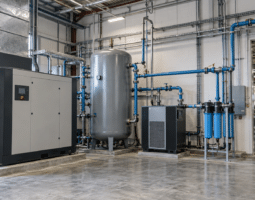
The air compressor is often called the “heart” of an industrial facility. When it beats reliably, production flows smoothly. When it fails, everything stops. However, even the highest-quality compressor will fail if it is installed poorly. A restricted intake, an undersized pipe, or a hot mechanical room can turn a state-of-the-art machine into a maintenance nightmare.
Designing an industrial air compressor installation requires more than just dropping a unit on a concrete pad and plugging it in. It requires a “total system” approach that accounts for air demand, ventilation, piping architecture, and future growth. Whether you are building a new facility or upgrading an aging utility room, this guide will help you plan a system that delivers reliable, clean air for years to come.
Phase 1: Assessing Air Demand
Before you select a location or buy pipe, you must accurately determine your facility’s air demand. A common mistake is sizing a system based on the horsepower of the old unit rather than the actual requirements of the plant.
Don’t guess. Conduct an air audit to measure your actual cubic feet per minute (CFM) usage. This ensures you aren’t paying for energy you don’t need or starving your tools of air during peak shifts.
Understand the difference between pressure (PSI) and flow (CFM). Many facilities increase PSI to fix a lack of power, when the real culprit is a lack of flow (CFM) or a restriction in the piping. Running at a higher pressure than necessary wastes energy—every 2 PSI increase costs roughly 1% more in electricity.
It is often recommended to size a system for your current demand plus 20% to accommodate future expansion. However, simply buying a larger fixed-speed compressor can backfire. If a fixed-speed unit is oversized for your current demand, it will cycle on and off rapidly (short-cycling), leading to premature wear and high energy bills.
If you are sizing for future expansion, strongly consider a Variable Speed Drive (VSD) compressor. A VSD unit can ramp down its motor speed to match your current lower demand efficiently, while holding the extra capacity in reserve for when your production grows.
Phase 2: Selecting the Optimal Location
Ideally, an air compressor should live indoors in a clean, well-lit, and temperature-controlled room. While outdoor installations are possible with specialized weather packages, indoor installations protect the unit from temperature extremes that cause condensation and oil viscosity issues.
Air compressors generate massive amounts of heat. In fact, roughly 80-90% of the electrical energy put into a compressor is converted into heat. If this heat is not removed, the room will overheat, causing the compressor to shut down on high-temperature alarms.
In the summer, you must have ductwork or exhaust fans capable of removing this heat from the building. In the winter, consider ducting the warm exhaust air into your plant to supplement space heating and lower your gas bill.
Never install a compressor in a closet or corner with zero clearance. Technicians need space to change filters, access the cooler, and service the motor. Leave at least 3 feet of clearance around all sides of the unit. If a technician cannot reach a component, it likely won’t get serviced, leading to premature failure.
Phase 3: Piping and Distribution Loop
The piping system is the “arteries” of your installation. If the pipe is too small or layout is poor, you will experience significant pressure drops, forcing the compressor to work harder than necessary.
Avoid a “dead-end” header design where air travels in a straight line to the end of the plant. Instead, install a loop system (or Ring Main). A loop allows air to flow in two directions to any point of use, equalizing pressure across the facility and preventing the “end of the line” machines from being starved of air.
Modern aluminum piping (like Infinity or FastPipe) is lightweight, corrosion-free, and uses leak-proof compression fittings. It offers the lowest friction and energy cost. Copper offers excellent durability but is expensive and labor-intensive to install. Black Iron is heavy and prone to internal rust. Over time, rust flakes will break off and damage your air tools. Never use PVC for compressed air. It becomes brittle over time and can shatter like a grenade under pressure, posing a severe safety hazard. OSHA strictly prohibits PVC for compressed air distribution.
Phase 4: Electrical Requirements
Industrial air compressors require stable, dedicated power. Before ordering equipment, verify your facility’s voltage and phase (e.g., 230V/3-phase vs. 460V/3-phase).
Electrical code typically requires a safety disconnect switch within sight of the machine. Ensure your breaker is sized to handle the “in-rush” current during startup, which can be significantly higher than the running amps (unless you are using a VSD compressor with a soft start).
Phase 5: Air Treatment and Condensate Management
Compressed air is wet and dirty. Without proper treatment, water and oil will ruin your pneumatic tools and contaminate your final product. Install a refrigerated dryer (for standard manufacturing) or a desiccant dryer (for critical, moisture-sensitive applications) to remove water vapor. Use particulate and coalescing filters to trap oil and dust.
Compressors produce gallons of oily water condensate daily. You cannot dump this down the drain. An Oil/Water Separator is required to filter the oil before the water is discharged, ensuring EPA compliance.
The Value of a Professional Design
A high-quality installation pays for itself in energy savings and reliability. A poorly planned system costs you money every minute it runs. Whether you are building a new facility or retrofitting an existing plant, Cullum & Brown offers complete system design and installation services. From sizing the load to running the final foot of aluminum piping, we ensure your system is built for the long haul.
Contact us today to discuss your air compressor installation project.